The Trade Fair Playbook: From initial planning to lasting impact
 © Lasse Buchhop
Remember to invite potential customers to visit your stand and ensure quick follow-up afterwards.
Exhibiting at trade fairs provides companies with unique opportunities to present their products and services to a target audience, make new contacts, and strengthen business relationships. Whether you are exhibiting at national or international trade fairs, professional and well-organised participation is key to success.
This guide is for those attending a trade fair, to help you prepare, participate, and follow up as effectively as possible.
Trade Fair Playbook
Select trade fairs that align with your goals and priorities
- Create your own event strategy and prioritise and score events according to a) relevance, b) impact and c) resources
- Choose a trade fair that aligns with your target audience and industry
- Research the trade fair’s history, conference topics, exhibitor profiles, attendee demographics, and other exhibitors/competitors
Key questions to consider:
- Will we meet our target audience?
- Are decision makers present?
- Will we be able to meet them and open a dialogue?
- Is it a good arena for networking in general?
- Is the event showcasing industry innovations?
Define objectives and activities
- Determine and define the overall purpose and objectives of participating in the trade fair
- Use a goal matrix for outlining possible key objectives, priority, success measurement, and timeline (see at the bottom of this page for an example)
- Decide on appropriate side activities:
- Research possible speaking/pitch option at conference / technical sessions
- Get an overview of the conference programme / technical sessions
- Customer events (dinners, demo, seminar, and others)
- Other networking events to attend
Budget and team planning
- Estimate the overall budget including booth space, design, technical set-up, administrative fees/insurance, logistics/freight, staffing, marketing, side events and travel/accommodation
- Get an early overview of all technical deadlines from the exhibition organiser in connection with your booth. (Water/Power accessibility, booking of furniture, AV equipment, Wi-Fi, etc.)
- Select the staff/team needed to achieve your prioritised goals (technical staff, sales/marketing, C suite level)
- Set up a team brief with clear coordination of objectives, expectations, and responsibilities
- Provide pitch training if needed
Booth design and layout
- Research the venue layout for high-foot traffic
- Book space as early as possible to secure the best location and take advantage of any early-bird pricing
- Choose a stand size and layout that align with your objectives and budget. A cohesive visual identity is essential:
- Open and inviting booth layout is easy to navigate
- Communicate clearly your value proposition and frame your narrative around impact: What problem are you solving, and for whom?
- Reinforce your messaging visually with signage, digital screens, presentations, video content, product displays/demos, etc.
- Take into account furniture for client meetings, storage, and product displays.
Pre-event marketing and promotion
- Have a clear plan for pre-event marketing and promotion that drives traffic to your stand
- Announce participation via email, website and social media
- Invite clients and prospects to visit your stand
- Remember to submit your company profile to the event organiser for exhibitor listing as soon as possible
- Consider upgrading the exhibitor marketing options available
- Prepare digital and print materials to be displayed at your stand
- Post daily updates on social media throughout the exhibition
Lead generation and networking
- Clear criteria for evaluating leads should be defined before the trade fair
- Who is a potential customer? What information is essential?
- If available, review delegate and exhibitor lists to identify possible leads
- Send guest invitations to potential leads (free or discounted visitor invites are often included in the exhibitor package)
- Use all available tools (apps, matchmaking services) provided by the event and/or pavilion organiser to schedule meetings
- Enterprise Europe Networking (EEN)
- Digital tools and systems based on artificial intelligence (AI) can help to capture contacts in a structured way and prioritise them automatically.
Post-show follow-up and ROI measurement
- Organise and prioritise all leads (hot/warm/cold)
- Verify contact details (email, phone, company, role)
- Follow up promptly with personalised emails or calls shortly after the event (preferably within 24–48 hours)
- Schedule calls or meetings promptly after initial outreach
- Consider creating fixed templates for follow-up emails
- Calculate ROI and analyse KPIs against goals
- Compare performance to last year or past events
- Conduct debrief with the team, summarise and document lessons learned and improvements for next event
- If you need help with contracts, securing payments, calculating tariffs, delivery terms, etc. we can help. Read more here:


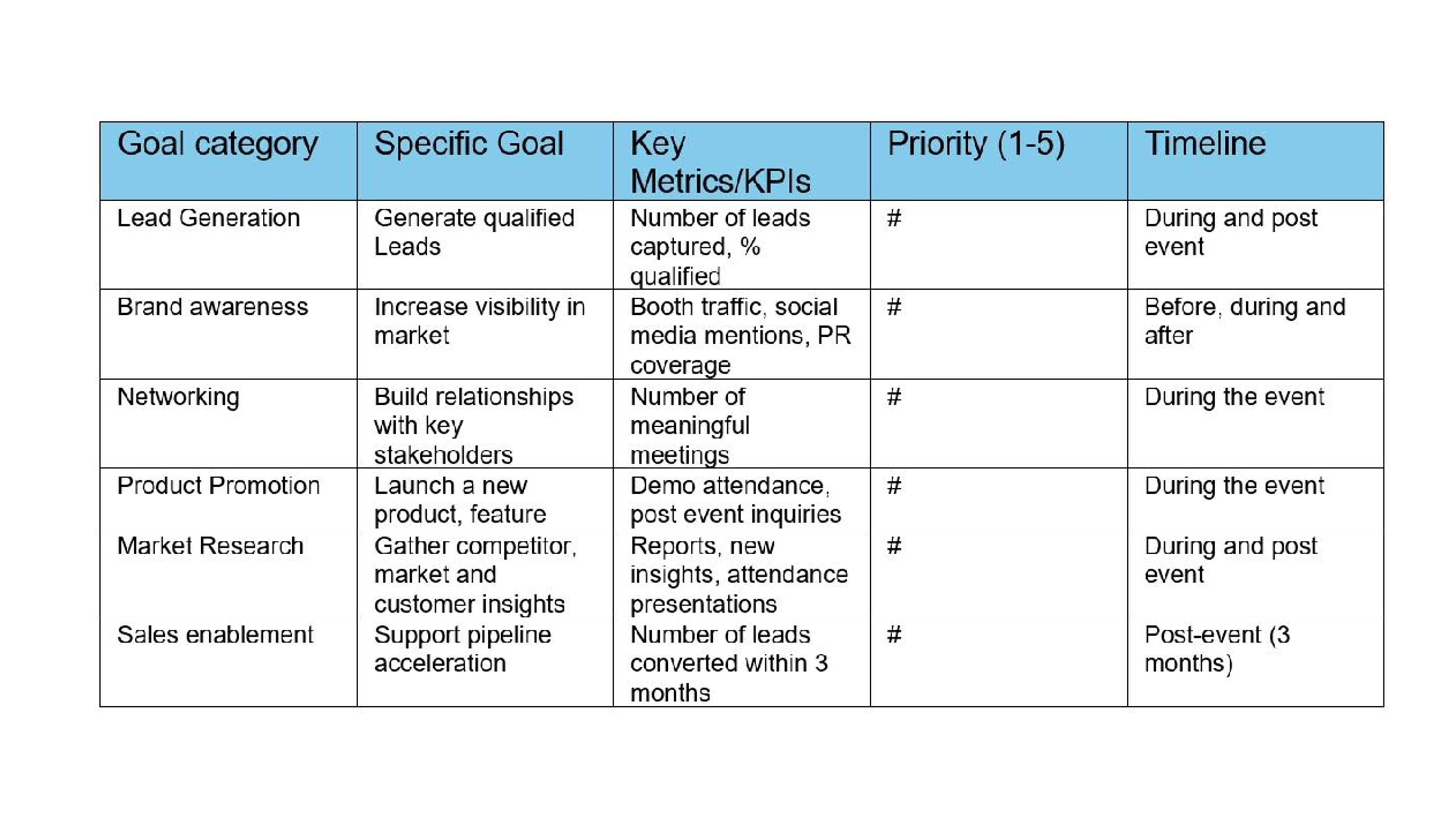
A goal matrix outlining possible key objectives, priority, how success can be measured, and timeline.
Publisert 3. des. 2025Sist oppdatert 5. jan. 2026